ECR Racing — Engineering
Designed from scratch.
Tested until it's right.
Every ECR Racing component starts with a blank sheet and a specific vehicle application. We don't adapt generic tooling — we engineer to the thermal, mechanical and dimensional demands of each application, then validate these before release.
Development Process
From specification to track.
The development of an ECR Racing brake system follows the same process regardless of whether it's a disc upgrade or a full big brake kit. No shortcuts.
Application Research
We start with the vehicle — its weight, power output, wheel size, OEM brake specification and intended use. Road, track day or competition each demand different disc sizes, caliper clamping forces and pad compounds. We don't assume a solution before we understand the problem.
Key inputs
- Vehicle kerb weight Confirmed
- Power output Confirmed
- OEM disc size Measured
- Wheel clearance Verified
Component Specification
Bell material, ring grade, disc diameter and thickness, bobbin specification, pad compound — each is selected for the specific application. Where we use suppliers, we write the specification. We don't accept what's available off the shelf.
Key decisions
- Bell alloy grade 7075-T6
- Ring iron grade High-carbon
- Bobbin radial clearance 0.1–0.3mm
- Axial float 0.3–0.5mm
Prototype Build
First articles are built to the specification and inspected dimensionally before any road or track testing begins. Fitment to the target vehicle is verified — caliper clearance, bracket alignment, wheel clearance — before the system goes anywhere near a road.
Checks
- Dimensional inspection 100%
- Caliper clearance Verified
- Wheel clearance Verified
- Bracket torque Confirmed
Road Bedding & Initial Testing
New systems are bedded in carefully on the road or track testing. We log pedal feel, initial bite, noise and dust behaviour. Any issues at this stage result in a specification change — not a compromise.
Measured
- Pedal travel Logged
- Initial bite Assessed
- NVH behaviour Logged
- Dust output Assessed
Track Validation
Every ECR Racing system is tested under sustained hard braking before release. We measure disc temperatures, check for judder or fade, and verify wear rates across multiple sessions. A system isn't released until it performs consistently under these conditions.
Measured on track
- Disc temperature Logged
- Fade resistance Assessed
- Wear rate Measured
- Judder / vibration Checked
Production Release
Once the system passes track validation, it's released to production. Every production unit is dimensionally checked before despatch. We don't ship anything we wouldn't put on our own car.
Before despatch
- Dimensional check 100%
- Surface finish Inspected
- Packaging Checked
- Documentation Included
Materials
Specified for performance.
Not for cost.
The two primary materials in our brake systems — the bell alloy and the disc iron — are chosen for performance, not price. There are cheaper options. We don't use them.
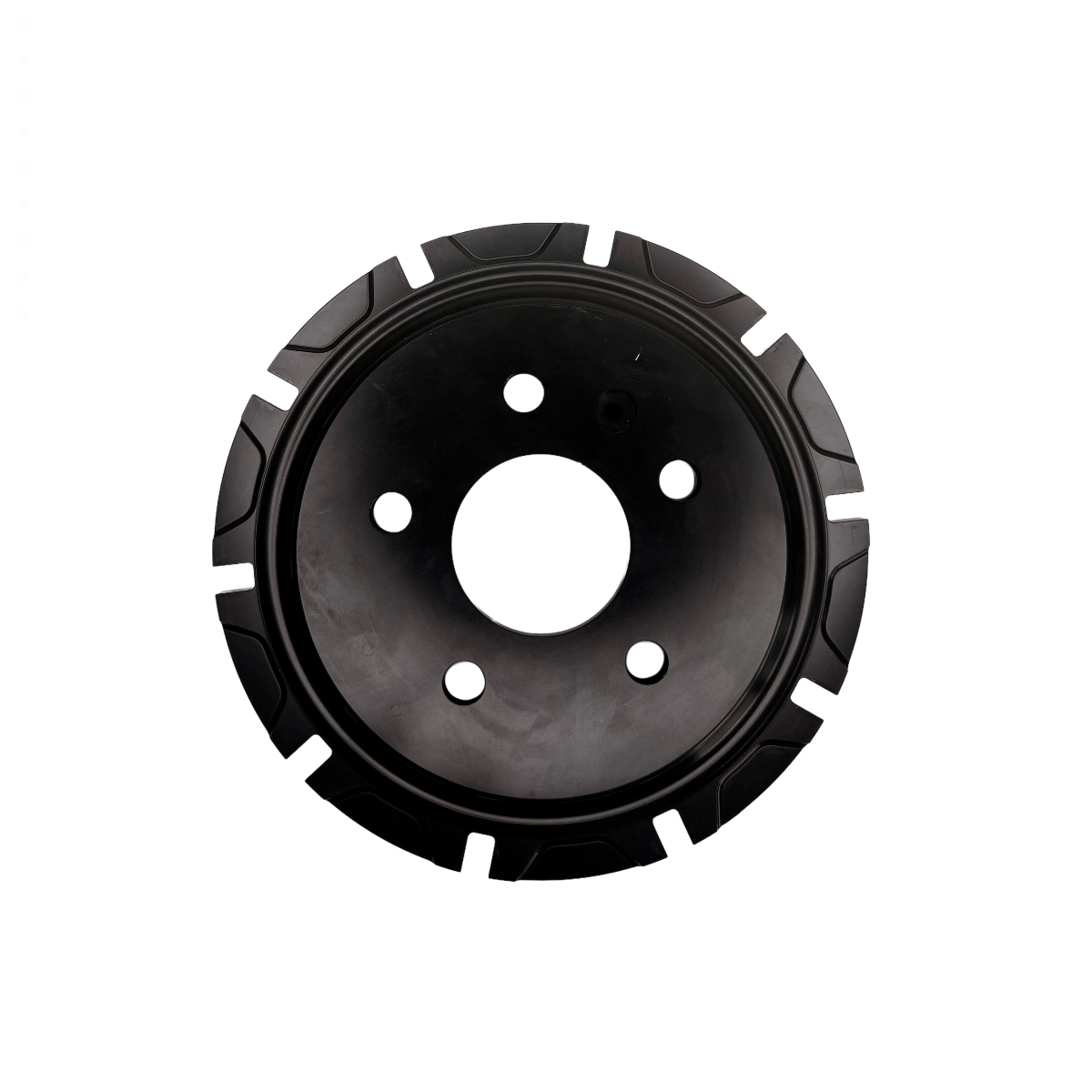
Bell — Aluminium Alloy
7075-T6 Aluminium
We specify 7075-T6 rather than the more widely used 6061-T6. The difference matters under repeated thermal cycling — 7075-T6 has higher tensile strength, better fatigue resistance and maintains its mechanical properties at the temperatures generated during sustained track use.
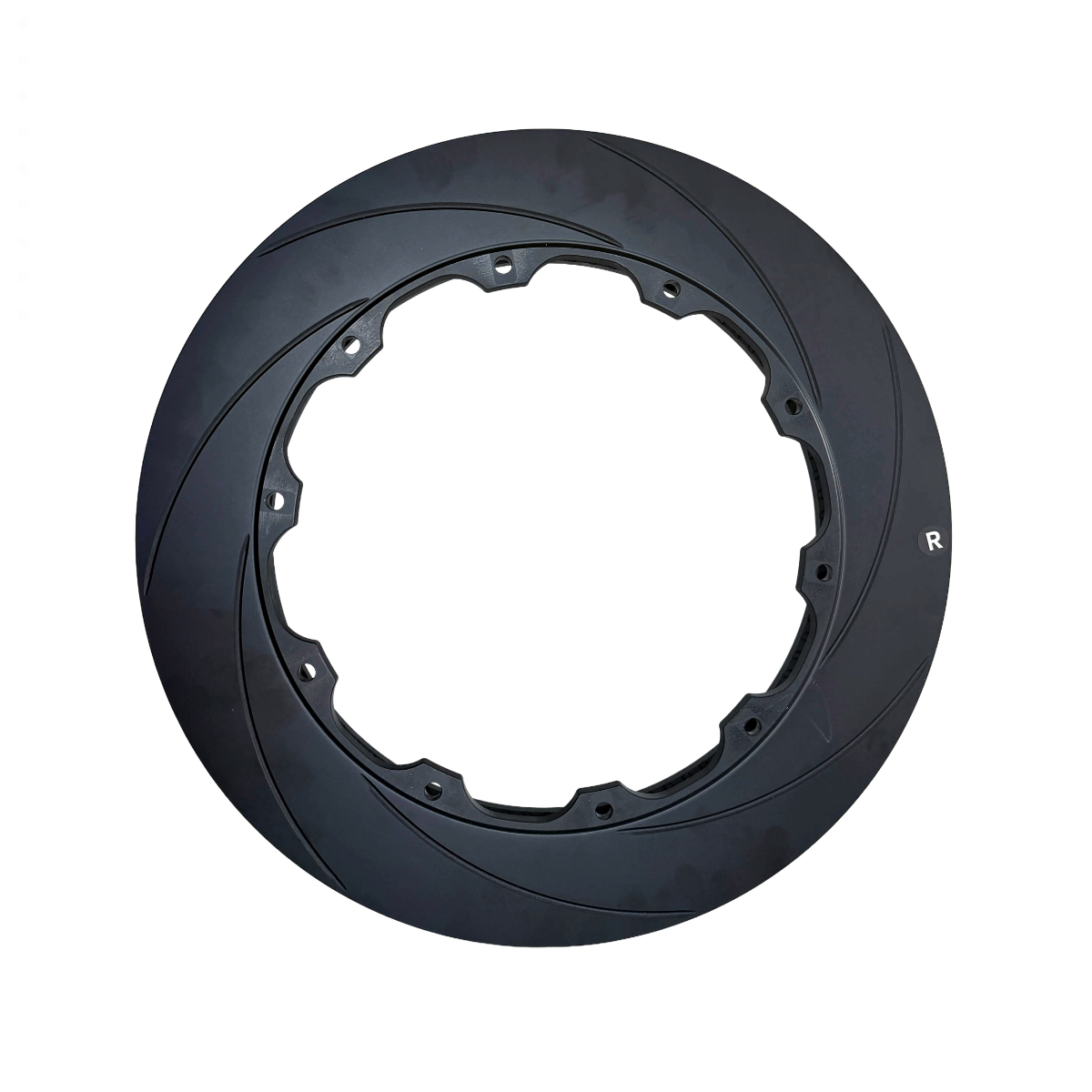
Ring — Cast Iron
High-Carbon Grey Iron
High-carbon grey iron is specified for its superior fade resistance, consistent friction characteristics and damping properties. It's the same material grade used in OEM sport brake packages on the performance vehicles we target — chosen by manufacturers for performance, not because it's cheap.
Manufacturing Tolerances
The numbers that matter.
The float between bobbin and bell slot. Too tight and the disc can't expand freely. Too loose and you get rattle and uneven wear.
How much the outer disc can move axially on the bell. Allows thermal growth without transferring stress to the bell or wheel hub.
Maximum allowable lateral runout on production discs. Exceeding this causes pedal pulsation and uneven pad wear.
Every disc is dimensionally inspected before despatch. Not batch sampled — every single unit.
Validation
Track tested.
Not just road tested.
Road testing tells you whether a brake system works. Combined High Temperature testing tells you whether it performs under sustained, repeated, braking. We do both.
What we test and why
Every new ECR Racing system goes through a structured test programme before release. We're looking for fade, judder, uneven wear and any signs of thermal distortion under conditions harder than most customers will ever experience.
If a system fails any part of this programme, it goes back for specification revision. We don't release products that haven't passed.
- Disc temperature logging under repeated hard stops
- Fade resistance assessment across multiple sessions
- Judder and vibration check after heat cycling
- Wear rate measurement over full test programme
- Pad bedding behaviour and consistency
- Pedal feel and modulation assessment
- Post-test dimensional inspection of disc and bell
Why ECR Racing
What separates us from the catalogue.
Most performance brake brands source products, badge them and sell them. We don't. Here's what that means in practice.
01
We write the specification
Where we use external suppliers, we specify the material grade, dimensions and tolerances. We don't accept standard products and put our name on it.
02
We test Extensively
Every system is validated under sustained scutiny before release. Road testing alone doesn't reveal fade, thermal distortion or wear behaviour under race conditions.
03
We inspect every unit
Every disc is dimensionally checked before despatch. Batch sampling isn't good enough when a brake component has safety implications.
04
Twenty years of application knowledge
We've been working on high-performance brake systems for over two decades. That knowledge is in every product we make — in the specification decisions that don't appear in a brochure.
05
We match the whole system
Caliper, disc, pad and bracket are engineered together. A mismatched system — right disc, wrong pad compound — performs worse than a well-matched standard system.
06
We stand behind what we sell
Every ECR Racing system carries a warranty. If something isn't right, we fix it. Twenty years of trading depends on that reputation.
See our products.
Three product lines. All engineered to the same standard.